|
“One does not become enlightened by imagining
figures of light, but by making the darkness
conscious. The later procedure, however, is
disagreeable and therefore not popular”.
C. G. Jung
E
live an
embodied
reality
characterized by the permanent experience of
complementary opposites. The ancient Chinese
philosophy observed this duality as the yin and
yang opposites (Carr & Mahalingam, 1997) as did
the ancient Hermetic philosophy expressed in its
4th Hermetic Principle, “everything
is dual; everything has poles; everything has
its pair of opposites” (Tree Iniciates, p.10).
Another Hermetic principle states the
correspondence between different planes and
levels of reality, “as above, so below; as
below, so above” (p.10). All of this suggests
that the dualistic universe we find in the
“outside world” has a correspondence also in our
“inner world”. Thus, in my opinion, the
challenge for humanity is to learn how to deal
with these opposites forces within daily life,
and achieve a balance between them through its
integration in our consciousness. The unbalanced
experience of opposites is the origin of human
suffering and an unpleasant life. As the Fourth
Holy Truth of Buddha teachings says, “[it] is
the Middle Way of practice that leads to the
cessation of suffering (dukkha)” (Harvey,
1990, p. 68). This Middle Way practice of
balancing these forces in ourselves implies the
transformation of our consciousness, the
“substance” that holds and experiences this
duality. Transformation is evolution, and only
begins when both complementary opposites are put
together. Life is created only when the
masculine and the feminine energy are combined.
As Hart (2000, p. 158) express it, “the energy
for growth is activated by the dynamic interplay
between these opposites”. An interplay that
takes place in this “cosmic game” we are all in,
in Grof terms (1998).
|
|
 |
|
Caroline Bassett (2005)
describes in an Emergent Wisdom model how wise
people are. The best expression of this key
point is in the constant transformation of the
self through the expansion of awareness in order
to integrate the paradox of life, together with
an active commitment for the common good. To my
mind, this transformation takes place throughout
the learning process of balancing and
integrating in the present both complementary
forces (masculine and feminine). A process that
takes place through the transformation of our
consciousness towards an expansion of awareness,
and which will lead us to express that inner
balance in the “outside world”. Doing so, we are
reaching higher levels of inner coherence
between thoughts, emotions, feelings and
actions, a coherence that brings us higher
levels of happiness, freedom, health, respect
and compassion expressed in our daily life. This
process of transformation passes through the
path of “knowing yourself” as inscribed in the
ancient Apollo temple of Delphi Oracle. Knowing
oneself is knowing the opposite forces and
dimensions that inhabit within us (most of the
time unconscious), and learning to integrate
them in our consciousness. This process takes
place only through the transformation of who
we are.
Within contemporary theory of
transpersonal psychology, we find two main
approaches that favour opposite paths of
transformation towards transpersonal. The
discussion between both theoretical approaches
had been called the “ascender/descender debate”
(Wilber, 1995). On one hand, we have the
immanent-horizontal-descending position, while
in the other a transcendental-vertical-ascending
position (Daniels, 2005, p.27). Wilber describes
both approaches as movements of the Spirit: “The
first is a descent of the One into the world of
the Many… the other is the movement of return or
ascent from the Many to the One” (1995, p.320).
As we see, out of the One there is always “Two”.
The metaphysical assumption of the One, and the
movement of consciousness towards it, approaches
the question of “what”, however, the movement
itself addresses the question of “how”, in other
words, how does transformation takes place?. To
my mind, there is more agreement on the “what”
rather than on the “how”, and here resides the
hot spot of the discussion between both
theoretical approaches. How do we integrate the
“Two” into the One? Which of the major
theoretical approaches manages to integrate
successfully both paths?
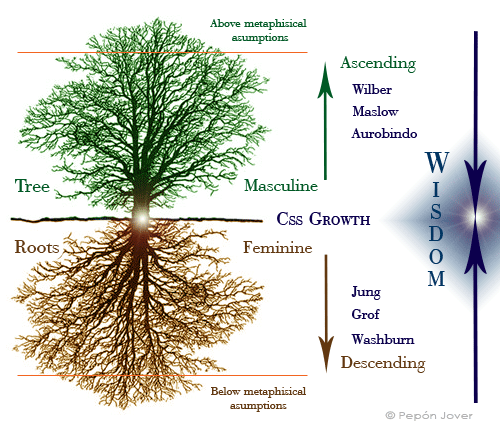
In order to approach the
answer to both questions, I will use the above
chart of the tree and wisdom to explain how I
understand transformation within duality. To
explain how one force helps the other in order
to activate the dynamic interplay between both,
as Hart pointed out, and which authors fit best
in the explanation of this interplay.
Within both theoretical approaches we find three
main representatives of each. In the ascending
position, we have Sri Aurobindo, Maslow
and Wilber. According to whom the developmental
purpose of human beings, in Burton Daniels
words, is: “to ascend and evolve within an
immense, all inclusive hierarchy (i.e.,
holarchy). Consequently, the individual is
thought to scale a great “ladder” of being, in
which her/his various levels spread out in a
ascending continuum overhead, reaching ever
higher into lofty states of awareness and
consciousness” (Daniels, 2004, p. 76). However,
in the descending path, again in Daniels words,
“is to descend and recover lost
aspects of themselves somehow jettisoned in the
process of their coming into being. […]
Consequently, the purpose of individuals is to
“heal” these divisive wounds and, in the
process, recover those aspects of being that
have been “split off” from awareness…” This
theoretical approach is represented by Washburn,
Grof, and Jung. To sum up, while the first ones
advocate ascending to “higher” consciousness
(masculine energy), the other ones advocate
descending to “deeper” consciousness (feminine
energy).
My proposal is that in order to ascend we
need at the same time to descend and by
doing so we develop wisdom, because we
integrate duality. This is a circular
transformation process that could be
represented as the growing tree dynamic that
lead us in Bassett words, “to deeper levels
of understanding, working and living in the
world” (2005, p. 6). The roots are
represented by the unconscious (basically
the psychological ones) and the feminine
energy. The top of the tree represents the
masculine energy and the unconscious higher
states of consciousness for daily awareness;
if we look up under the tree we won’t see
the top, we need to be in or step out in
order to see. Consciousness (Css)
development is represented by the growth of
the tree in both ways, upwards and downwards.
A tree, in order to grow upwards with
strength and healthiness needs to develop in
the same measure roots below ground of the
same size and depth. If a tree does not have
big enough roots to hold the top, when
problems come like a flood, a storm or
strong winds, they will uproot the tree
taking it away. In the same sense, in order
for consciousness to grow upwards it also
needs to develop strong roots, well attached
to ground. In order to reach higher
altitudes (higher states of consciousness)
the tree needs to develop deeper roots to
hold the whole structure. The same happens
with the transpersonal psychological
development. Consciousness grows by
expanding itself like the tree towards upper
and deeper levels of awareness of our
psyche, in order to know, integrate and
balance our duality.
This integration takes
place in what I call the hara’spoint
of the tree,
at ground level, where the bright spot is
represented. This spot means to bring higher
and deeper consciousness to the present.
That is why I bring both arrows to the same
point. In an excellent article by Welwood,
he differentiates spiritual realization
from actualizing it by explaining
that the first one is the movement from
personality to being, while the second, is
integrating the liberation from the prison
of the conditioned self into the fabric of
one’s embodiment and one’s daily life, and
that happens through personal transformation
(1999, p. 169-170). In my opinion, because
we are living in this embodied reality in a
social environment, we need to bring higher
and deeper dimensions of our psyche to our
daily life, integrating them in our
consciousness in order to let them be
expressed in a balanced way through social
interaction: wisdom.
| |
 |
|
We observe then a
movement of consciousness: an expansion
of awareness up and down within psyche
dimensions (vertical axis), to bring
that knowledge to the present, and from
there, another expansion of
consciousness in a horizontal axis
expressing what has being integrated in
our consciousness to the world’s social
dimensions. And back again, the
horizontal dimension feeds the vertical
one, and so forth in an interdependent
pattern. In the centre rests the One
which is reached by expanding our
consciousness vertically and
horizontally in this dynamic process. In
the middle there is no space, no time,
no movement, no transformation and no
“Two”. It is in this centre where some
mystical states are experienced, for
example, nondual ones (Daniels, 2005, p.
258). We are already in the One but we
are not conscious of it, that’s why we
need to expand our consciousness
throughout the dynamic interplay of
duality to return again to the One; and
an “embodied One”, only happens through
personal transformation in a vertical
and horizontal axis to live the
interconectedness of everything, to
understand and experience the
holomovement (Bohm, 1980) of the One
in our consciousness.
We have now reached a
point in this essay where we can ask
again, which authors’ theories manage to
integrate successfully both paths to
develop a “wise embodied life”? As the
above quote of Jung says, “one does not
become enlightened by imagining figures
of light, but by making the darkness
conscious” Jung (1967, p. 335).
Therefore, this is to me like the
Egyptian Ankh, the key of life and death
that should guide any process of
transformation towards wisdom, towards
the One, because the One remains
unconscious to our daily awareness. In
my opinion, the authors that integrate
most this duality are Roberto Assagioli
(1993) in the vertical axis, and Jorge
Ferrer (2002, 2006) in the horizontal
one. The first one focuses his theory on
an integral transformation of the lower,
middle and the higher unconscious into
the conscious Self or “I”. A
transformation called Psychosythesis.
And the second author because is setting
transpersonal development within a
social context and embracing all truths
and paths, integrating the
multidimensional reality of human
beings.
Assagioli points out
that “in our ordinary life we are
limited and bounded in a thousand ways”
(p.20), and that limitations generate
suffering and unsatisfied life.
Psychosynthesis is a transformative path
to help people free themselves “from
this enslavement and achieve an
harmonious inner integration, true
Self-realization, and right
relationships with others” (p.21). This
transformational goal seems to me to be
akin to the development of a “wise
embodied life” integrating in our daily
consciousness (in the hara) all
levels of our psyche (the lower and
higher regions), and thus expanding our
awareness. He also points out, that “a
living human is not a building”, meaning
that “the carrying out of the vast inner
program of psychosynthesis may be
started from various points and angles
at the same time” (p. 29), therefore, it
does not mean to follow a rigid and
linear path to conquer Self-realization.
Like trees, each one develops its roots
and branches in different ways,
directions, rhythms, sizes, and beauty.
Psychosynthesis, for
Assagioli, is a dynamic portrayal of a
“constant interplay and conflict between
the many different and contrasting
forces” (p.30). As I have said at the
beginning, in my opinion the challenge
of humanity is to learn how to deal and
balance the opposite forces so that
dukkha or suffering disappears. To
my mind, Assagioli is building up a
psychological model of personality and
clinical change to pursue the Middle Way
and balance those forces in order to
“control, harmonize and utilize them”
(p.30). Although Assagioli, as a
psychoanalyst, is more focused in
personal and transpersonal integration,
he also takes on account
inter-individual and cosmic
psychosynthesis (a more horizontal
axis). These are the reasons why I think
it manages to integrate both the
ascending and descending positions.
In the other hand,
Ferrer is also managing to integrate
them, and hence developing a way to
wisdom. In his Participatory Vision
theory (2002) he explains that spiritual
knowing is a participatory event because
“spiritual energies are not confined to
our inner world, but can also flow out
of relationships, communities, and even
places” (p.115). Thus, transpersonal
development takes place within social
contexts. Indeed, to be human implies to
be socialized in a human environment (Tajfel,
1978, Vygotsky, 1978, 1987). As a
consequence, our “inner world” is
constructed by the “outside world” where
our experience of life takes place. As
Ferrer points out, this participatory
understanding “helps us avoid the
dangers of spiritual narcissism and
integrative failure” (p.115).
Furthermore, I think and believe as
Ferrer, that “the ultimate aim of the
transpersonal vision is to bring forth a
transpersonal world” (p. 7). And in
order to achieve this, to be fully
embodied beings is necessary, so that,
as he points out, “spirituality emerges
from the creative interplay of both
immanent and transcendent spiritual
energies in individuals who embrace the
fullness of human experience while
remaining firmly grounded in body and
earth (2006, p. 42).
Notes:
Hara
in Japanese or Dantian in Chinese
philosophy, represents the vital centre of
gravity, the body’s central axis or the centre
of the self.
References:
Assagioli, R. (1993). Psychosynthesis: The
Definitive Guide to the Principles and
Techiniques of Pschosynthesis. London:
Thorsons.
Bassett, C. (2005). Emergent Wisdom: Living a
Life in Widening Circles. ReVision: Journal
of Consciousness and Transformation. Vol. 27,
No. 4. pp. 6-11
Bohm,
D. (1980). Wholeness and the Implicate Order.
RKP
Carr,
B. & Mahalingam, I. (1997). The origins of
Chinese Philosophy, Chung-ying Cheng. In
Companion Encyclopaedia of Asian Philosophy.
London: Routledge. pp. 503-506.
Daniels, B. (2004). The Trans/Trans Fallacy and
the Dichotomy Debate. The International
Journal of Transpersonal Studies. Vol. 23
pp. 75-90
Daniels, M. (2005). Shadow, Self, Spirit:
essays in transpersonal psychology. Exeter:
Imprint Academic
Ferrer,
J. (2002).
Revisioning transpersonal theory :a
participatory vision of human spirituality.
New York State U.P.
Ferrer,
J. (2006). Embodied Spirituality: Now and Then.
May/June,
www.tikkun.org, pp. 41-64
Grof,
S. (1998). The Cosmic Game: Explorations of
the Frontiers of Human Consciousness. New
York: State University of New York Press.
Hart,
T. (2000). Transformation as process and
paradox. The Journal of Transpersonal
Psychology, 2000, Vol. 32, No. 2, pp.
157-164
Harvey, P. (1990). An introduction to
Buddhism. Teachings, history and practices.
Cambridge: Cambridge University Press.
Jung,
C.G. (1967). Alchemical studies.
Routledge & Kegan Paul.
Tajfel,
H. (1978). Chapter 12: The Structure of our
Views about Society. In Tajfel, H. & Fraser,
C. Introducing social psychology. England:
Penguin Books. pp. 303
Three
Initiates, (2006). The Kybalion: A Study of
Hermetic Philosophy of Ancient Egypt and Greece.
Cosimo Inc.
Vygotsky, L.S. (1978). Mind in society: The
development of higher psychological procesesses.
Cambridge, MA: Harvard University Press.
Vygotsky, L.S. (1987). The collected works of
L.S. Vygotsky (J.S. Bruner, Trans.). New
York: Plenum Press.
Walach,
H. (2005). Higher Self – Spark of the Mind –
Summit of the Soul: Early History of an
Important Concept of Transpersonal Psychology in
the West. The International Journal of
Transpersonal Studies. Vol. 24. pp. 16-28
Welwood, J. (1999). Realization and Embodiment:
Psychological Work in the Service of Spiritual
Development. The International Journal of
Transpersonal Studies. Vol. 18, No. 2. pp.
160-186
Wilber, K. (1995). Sex,
Ecology, Spirituality: The Spirit of Evolution.
Boston & London: Shambhala
Subir al inicio.
|